

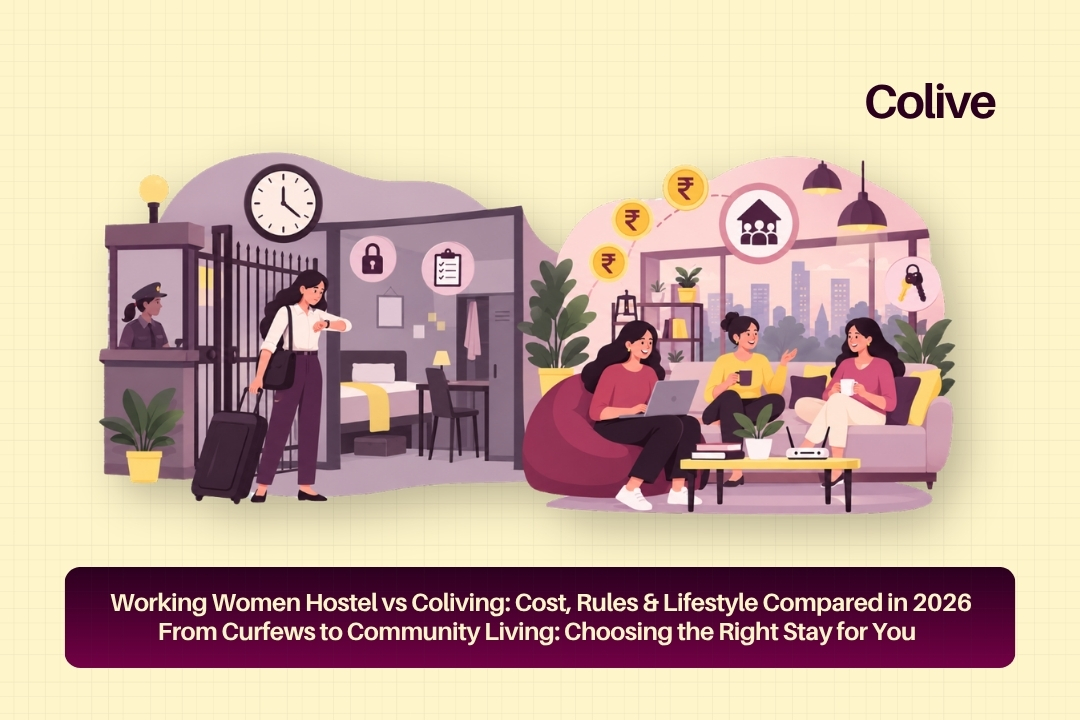
Working Women’s Hostel vs Coliving (2026): Sakhi Niwas Rules, Real Costs and Which One Fits You
A government working women’s hostel under the Sakhi Niwas scheme charges a maximum of 15% of your salary for a single room, 10% for a double and 7.5% for a dormitory bed. You qualify only if your gross income is Rs 50,000 a month or less in a metro, Rs 35,000 elsewhere. On price, nothing private competes with that.
The bigger problem is availability. An MWCD RTI response reported 525 functional hostels in May 2025 with 42,230 beds, 89.2% of them occupied, and only 19 new hostels were sanctioned nationally in the five years to August 2024. A private women’s hostel costs Rs 6,000-14,000 a month with food. Coliving starts at Rs 7,000 in Bangalore and Pune and Rs 5,000 in Hyderabad, with zero deposit and a written agreement.
Every August and September a fresh cohort of women moves to Bengaluru, Hyderabad, Pune and Chennai for a first job, and most of them run the same search: working women hostel. What comes back is a Google local pack, three listing directories and two state government pages. Almost nothing explains how the government scheme works, what it costs, or how long the wait for a room is likely to be.
This guide answers all three, using the scheme’s own rules and the government’s own supply numbers, then compares the government option against a private hostel and a managed coliving room so you can decide on facts. Live rooms are on our PG in Bangalore and women’s PG in Bangalore pages when you’re ready to compare.
Quick facts
| Sakhi Niwas rent cap | 15% of salary for a single, 10% double, 7.5% dormitory |
| Income eligibility | Rs 50,000/month gross in metros, Rs 35,000 elsewhere |
| Functional hostels | 525 (MWCD RTI response, May 2025); 523 operational per PIB, January 2025 |
| Beds available vs occupied | 42,230 total, 37,664 occupied, 89.2% (May 2025 RTI data) |
| New hostels sanctioned, 5 years to Aug 2024 | 19 nationally, 13 built |
| Private women’s hostel rent | Rs 6,000-14,000/month with food (market estimate; varies by city) |
| Coliving entry (Colive, checked 11 Aug 2026) | From Rs 7,000 Bangalore and Pune, Rs 5,000 Hyderabad, zero deposit |
| Children in government hostels | Girls up to 18, boys up to 12, per scheme guidelines |
| Maximum stay | 3 years, extendable to 5 in exceptional cases |
Which one should you pick?
The short answer first, then the evidence.
| Your situation | Go for |
|---|---|
| Gross salary under Rs 50,000, and you have a young child | Sakhi Niwas, where a day care facility is available. No private option matches it. |
| Under the income ceiling, flexible on timing, can wait | Sakhi Niwas. Apply, then rent something meanwhile. |
| Under the ceiling but you need a room this month | Private hostel or coliving. An 89.2% occupancy rate means waiting lists. |
| Above the income ceiling | Private hostel or coliving. You’re not eligible for the scheme. |
| Night shifts, rotational shifts, or frequent work travel | Coliving, where the property’s rules permit late entry. Check before booking. |
| New to the city, moving alone, no local contacts | Coliving. A written agreement and a managed building are worth the premium. |
| Lowest possible price with food | Private hostel with a reputation you can verify in person. |
| Lowest upfront cost | Zero-deposit coliving. |
| Likely to change office or city within a year | Coliving. Transferring beats a fresh deposit and a fresh hunt. |
The strategy that fits most women under the income ceiling is in the section apply for the hostel, book a room to wait in: do both at once, because applying and renting are not mutually exclusive.
What counts as a “working women’s hostel”
Two different things share the name. Mixing them up is why most advice on this topic is confusing.
The first is a government-funded hostel under Sakhi Niwas. The older Working Women Hostel scheme was renamed Sakhi Niwas and brought under Mission Shakti with effect from 1 April 2022, run by the Ministry of Women and Child Development. Central funds go to states and union territories, which run the hostels directly or through implementing organisations. Rent is regulated by formula and eligibility is checked against your salary.
The second is a private hostel that markets itself to working women. These operate under their own pricing, admission criteria and house rules, which vary by operator and location. Everything you see on Justdial, Sulekha and Magicbricks under this search term is this second category.
They are not comparable on price, so this guide keeps them apart.
Sakhi Niwas: who qualifies
The figures in this section come from the Ministry of Women and Child Development’s scheme documents. Visible sources are listed at the end of the article.
The scheme’s stated purpose is “to promote availability of safe and conveniently located accommodation for working women,” in urban, semi-urban and rural areas alike, with day care for residents’ children as an important component of the scheme.
The income ceiling
| Where you live | Maximum gross monthly income |
|---|---|
| Metropolitan cities | Rs 50,000 |
| Everywhere else | Rs 35,000 |
This is gross consolidated income, not take-home. A software engineer two years into a Bengaluru job is usually above it. A first-year associate, a nurse, a teacher, a BPO or retail employee usually isn’t.
Worth knowing, and rarely advertised: the district administration can relax these limits based on local conditions and room availability. If you’re marginally over, ask instead of assuming.
Marital and family status
You’re eligible if you’re single, widowed, divorced or separated. Married women qualify too, as long as your husband or immediate family doesn’t live in the same city or area. Women undergoing job training are covered as well.
Priority goes to women from disadvantaged sections, and women with physical disabilities get special preference.
Children
Under the scheme guidelines, girls up to the age of 18 and boys up to the age of 12 can stay with their working mothers. The scheme includes provision for a day care centre for residents’ children, arranged on a need basis and as a paid service, so confirm with the specific hostel whether one is running. Where it is, it’s the single strongest reason to choose a government hostel: coliving operators don’t offer child care, and almost no private PG accepts children at all.
How long you can stay
Three years is the standard cap. The district administration can extend it a year at a time in exceptional circumstances, to a maximum of five years total. That makes this a launchpad rather than a long-term home.
What a Sakhi Niwas hostel costs
Rent is a share of what you earn, not a market rate. That’s why nothing private competes with it on price.
| Accommodation type | Maximum charge |
|---|---|
| Single bedroom | 15% of your total emoluments |
| Double bedroom | 10% |
| Dormitory | 7.5% |
| Day care for your child | 5% of your emoluments, or actual cost, whichever is lower |
Mess charges are separate, and so are extras like washing machine use.
Working example. A woman earning Rs 45,000 gross in Bengaluru pays at most:
- Rs 6,750 a month for a single room
- Rs 4,500 for a double
- Rs 3,375 for a dormitory bed
- Rs 2,250 for day care if she has a young child
Food sits on top of that. Even so, Rs 3,375 for a dormitory bed sits well under every private room in the city. Compare it with the Rs 7,000 entry point on a managed coliving room and the gap is obvious.
So the price question has a clear answer. The availability question is where it gets harder.
Availability: what the government’s own numbers show
The figures in this section come from parliamentary replies, a Press Information Bureau release and an RTI response, each dated below.
- A Ministry of Women and Child Development RTI response in May 2025 reported 525 functional hostels, with 42,230 beds of which 37,664 were occupied, an occupancy rate of 89.2%. A hostel network running at 89% full means waiting lists, not vacancies.
- A PIB release of 31 January 2025 reported 523 operational hostels supporting 26,306 women, in the ministry’s year-end review for 2024.
- Government-reported counts have varied considerably across reporting periods: 607 hostels were cited by a parliamentary committee in 2006, 494 in a December 2023 parliamentary reply, 463 in December 2024 data and 525 in the May 2025 RTI response. The reporting methodologies differ, so treat any single count as a snapshot rather than a trend.
- What the data does show clearly is limited expansion. A Rajya Sabha reply reported in August 2024 put new sanctions under Sakhi Niwas at 19 hostels in five years, of which 13 were built, covering only 10 of India’s 28 states. No new hostels were sanctioned in FY2022-23 or FY2023-24, per a Rajya Sabha statement of 24 July 2024.
- Distribution is uneven. Per the May 2025 RTI data, Kerala has 138 hostels, more than any other state, while several states have none.
- New supply is coming, slowly. Punjab has announced six new working women’s hostels housing at least 800 women by the end of 2026, across Mohali, Amritsar, Bathinda and Jalandhar.
Set that against demand: female migration within India rose 101% between the 2001 and 2011 censuses, and women make up about 27% of the Indian labour force.
The practical takeaway. If you’re under the income ceiling, apply. It costs one phone call and the capped rent is unmatched. Then arrange somewhere to live while you wait, because at 89.2% occupancy you should expect to wait.
Private working women’s hostels
Prices in this section are market estimates from current listings and vary by city and property.
These fill the gap the government leaves. Quality varies from excellent to grim, sometimes on the same street.
What you usually get: a bed in a two, three or four sharing room, two or three meals a day, a shared bathroom and Wi-Fi. Security is the wildcard. Some buildings have biometric entry with logs; some have a watchman with a notebook.
What it costs: roughly Rs 6,000 to Rs 14,000 a month with food, depending on the city and sharing type. Chennai and Coimbatore sit at the lower end, Bengaluru, Hyderabad and Mumbai at the higher.
What actually varies, and what to ask:
- Is there a written agreement, or only a receipt? A receipt gives you nothing if a deposit is withheld.
- What is the notice period, and what happens to the deposit if you leave early?
- What are the entry rules, and how are they enforced? Ask specifically what happens when a shift runs late.
- Is food included or billed separately, and can you eat one meal there before deciding?
- Who else holds a key to your room?
The deposit is where most disputes begin. Ask exactly what can be deducted from it, and get that answer in writing before you transfer anything.
Coliving: What Changes
Coliving is a managed rental. One operator holds the lease, furnishes the building, runs housekeeping and maintenance, and signs an agreement with you directly. The bed looks like a hostel bed. Everything around it works differently.
What that means day to day:
- One monthly payment covering rent, Wi-Fi, housekeeping and utilities instead of five separate ones
- A written agreement with a stated notice period, so a deposit dispute has a document behind it
- A named maintenance channel rather than an individual landlord
- Entry rules set per property rather than a blanket curfew; if you work shifts, confirm the specific property’s policy before booking
- The ability to move between properties and cities without a fresh house hunt
What it costs. Colive figures below were checked against live Colive property pages on 11 August 2026. Colive rooms start at Rs 7,000 a month with zero deposit in Bangalore and Pune, and Rs 5,000 in Hyderabad, with a Rs 2,000 reservation amount at booking that adjusts at check-in. In Bangalore that spans 120+ properties, 118+ of them offering women’s accommodation across Marathahalli, Bellandur, Whitefield, Electronic City, Silk Board and Koramangala. Pune twin sharing typically runs Rs 8,000-12,000 past the entry rate.
The zero-deposit figure is the number to compare, not the rent. A conventional PG asking for two months as deposit wants Rs 14,000 to Rs 20,000 from you before you’ve slept a night in the building. For anyone moving cities on a first salary, that’s the real barrier.
Where coliving loses, plainly. It costs more than a Sakhi Niwas dormitory bed and always will, and it doesn’t take children. If you’re a mother earning under Rs 50,000 near a hostel with a day care centre, the government option is the better answer.
City pages with live rooms and rents: PG in Bangalore, women’s PG in Bangalore, PG in Hyderabad and PG in Pune.
The three options side by side
| Sakhi Niwas (government) | Private women’s hostel | Coliving | |
|---|---|---|---|
| Monthly cost | 7.5%-15% of your salary | Rs 6,000-14,000 | From Rs 5,000-7,000 |
| Income limit | Rs 50,000 metro, Rs 35,000 elsewhere | None | None |
| Deposit | Not the norm | Often 1-2 months | Zero at Colive, Rs 2,000 token |
| Food | Mess, charged separately | Usually included | Property dependent |
| Day care / children | Girls to 18, boys to 12; day care where available | Rare | No |
| Entry rules | Hostel-specific | Hostel-specific, often curfewed | Property-specific; typically no blanket curfew |
| Written agreement | Depends on the implementing organisation | Sometimes | Yes |
| Maximum stay | 3 years, 5 with extension | No limit | No limit |
| Realistic availability | 89.2% occupied nationally (May 2025) | Wide | Wide across metro cities |
| Move between cities | Reapply from scratch | Reapply from scratch | Transfer within the network |
Apply for the hostel, book a room to wait in
This is the strategy that fits most women under the income ceiling, and it deserves its own section because almost nobody spells it out: do both at once.
- Call your district Women and Child Development office and ask two questions: is there a sanctioned working women’s hostel here, and how long is the waiting list. Karnataka publishes its working women’s hostel list on the DWCD Karnataka site; Delhi and Chennai district publish theirs too.
- Submit the application and keep the reference number. Documents: employment proof, a salary certificate showing gross monthly income, photo ID, and age proof for any child staying with you.
- Ask whether the district administration has relaxed the income ceiling locally. The scheme permits it and it’s never advertised.
- Book a no-lock-in room for the wait. A zero-deposit coliving room costs you nothing to leave when the hostel place comes through, which is exactly what you want while you’re on a list.
Applying and renting are not mutually exclusive, and treating them as a sequence rather than a choice is how most people lose months.
What residents actually complain about
Read past the brochures and the complaints repeat across both private hostels and PGs: windowless partition rooms, house rules that appear only after you’ve paid, food quality declining after the first month, and deposits that shrink on the way out.
Use that as your inspection list:
- Ask to see the actual room, not the show room, and check it has a window. Converted buildings partition big rooms into windowless singles and charge single rates for them.
- Get the rule sheet in writing: entry timings, guest policy, notice period. A spoken “we’re flexible” isn’t a policy.
- If food is bundled, eat one meal there before you decide. Then ask a resident how it holds up after a month.
- Ask who manages the building. A resident manager with entry logs is a different product from a caretaker with a register.
- Ask what can be deducted from the deposit, itemised, in writing, before you pay anything.
Our longer version of this is in the guide to safety checks before booking a PG for women in Bangalore, written for exactly this decision. If you’re looking at a specific area, the ladies PG in Bellandur guide and the ladies PG options in Koramangala cover rents and how to verify street by street. For Pune, start with safe PGs for women in Pune.
About Colive
Deciding where to live alone in a new city is really deciding who to trust with your safety and your deposit, so here is what’s behind the brand, briefly.
Colive operates a managed rental network that has housed over 15,000 single professionals and young couples, with 120+ properties in Bangalore alone and women’s accommodation at 118+ of them. Rooms are furnished, entry is biometric, and rent, Wi-Fi, housekeeping and utilities come in one bill under a written agreement. The company’s work on the rental model has been covered by national press including Deccan Herald, The Financial Express, The Asian Age, Hans India and Deccan Chronicle; the coverage is collected on the Colive awards and recognition page.
Press coverage is not a safety guarantee and shouldn’t be read as one. Visit the property, meet the manager, and read the agreement. What a track record tells you is that there’s a registered company behind the building with a reputation to lose.
FAQs
What is the working women hostel scheme?
Sakhi Niwas is the Government of India’s working women hostel scheme, run by the Ministry of Women and Child Development under Mission Shakti. It was renamed from the older Working Women Hostel scheme with effect from 1 April 2022. Central funds go to states and union territories, which run hostels directly or through implementing organisations, providing safe accommodation for working women with provision for day care for residents’ children.
What is the income limit for a working women’s hostel?
Gross consolidated monthly income of Rs 50,000 in metropolitan cities, and Rs 35,000 everywhere else. This is gross, not take-home. The district administration can relax the limit depending on local conditions and available rooms, so it’s worth asking if you’re marginally over.
What is the monthly rent for a government working women’s hostel?
Rent is capped as a share of your salary rather than set at a fixed rate: up to 15% of your total emoluments for a single room, 10% for a double and 7.5% for a dormitory bed. Day care is capped at 5% of the mother’s emoluments or the actual cost, whichever is lower. Mess charges are billed separately. On a Rs 45,000 salary that works out to about Rs 6,750 for a single or Rs 3,375 for a dormitory bed.
How many working women’s hostels are there in India?
An MWCD RTI response reported 525 functional hostels in May 2025, with 42,230 beds of which 37,664 were occupied, an 89.2% occupancy rate. A PIB release of 31 January 2025 reported 523 operational hostels supporting 26,306 women. Only 19 new hostels were sanctioned in the five years to August 2024, covering 10 of 28 states.
Can married women stay in a working women’s hostel?
Yes, provided your husband or immediate family doesn’t live in the same city or area. Single, widowed, divorced and separated women are eligible, and so are women undergoing job training.
Can I keep my children with me in a working women’s hostel?
Under the scheme guidelines, girls up to the age of 18 and boys up to the age of 12 can stay with their working mothers. The scheme provides for day care centres on a need basis as a paid service; confirm with the specific hostel whether one is running.
How long can I stay in a working women’s hostel?
Three years is the standard maximum. The district administration can extend it by up to a year at a time in exceptional circumstances, to a maximum of five years in total.
Is a working women’s hostel cheaper than a PG or coliving?
A government Sakhi Niwas hostel is cheaper, because rent is capped at a percentage of your salary instead of set by the market. A private women’s hostel and a coliving room cost broadly the same, and coliving usually adds a written agreement, housekeeping, utilities in one bill and property-level flexibility on entry timings. Colive rooms start at Rs 7,000 in Bangalore and Pune and Rs 5,000 in Hyderabad, with zero deposit.
Are there working women’s hostels in Bangalore?
Yes, both government-funded and private. Government rooms are limited and usually waitlisted; the Karnataka Women and Child Development department publishes the sanctioned list. For private managed options, Colive lists 118+ women’s PGs across Bangalore starting at Rs 7,000 with zero deposit, across Marathahalli, Bellandur, Whitefield, Electronic City, Silk Board and Koramangala.
What if I earn too much to qualify for Sakhi Niwas?
Then the choice is between a private women’s hostel and coliving. Compare the deposit before you compare the rent. A PG asking two months up front costs Rs 14,000-20,000 on day one, which is more than a full year of paying Rs 1,000 extra in monthly rent at a zero-deposit property.
Start with one phone call each way
Call the district Women and Child Development office about the hostel waiting list, and compare live coliving rooms while you wait. Colive rooms start at Rs 7,000 a month in Bangalore and Pune and Rs 5,000 in Hyderabad, zero deposit, Rs 2,000 token that adjusts at check-in, video tours from any city. Compare rooms on the women’s PG in Bangalore page, or call 7676 000 500 with your joining date.